AWS Demonstrates AI Recruitment Assistant Using Bedrock
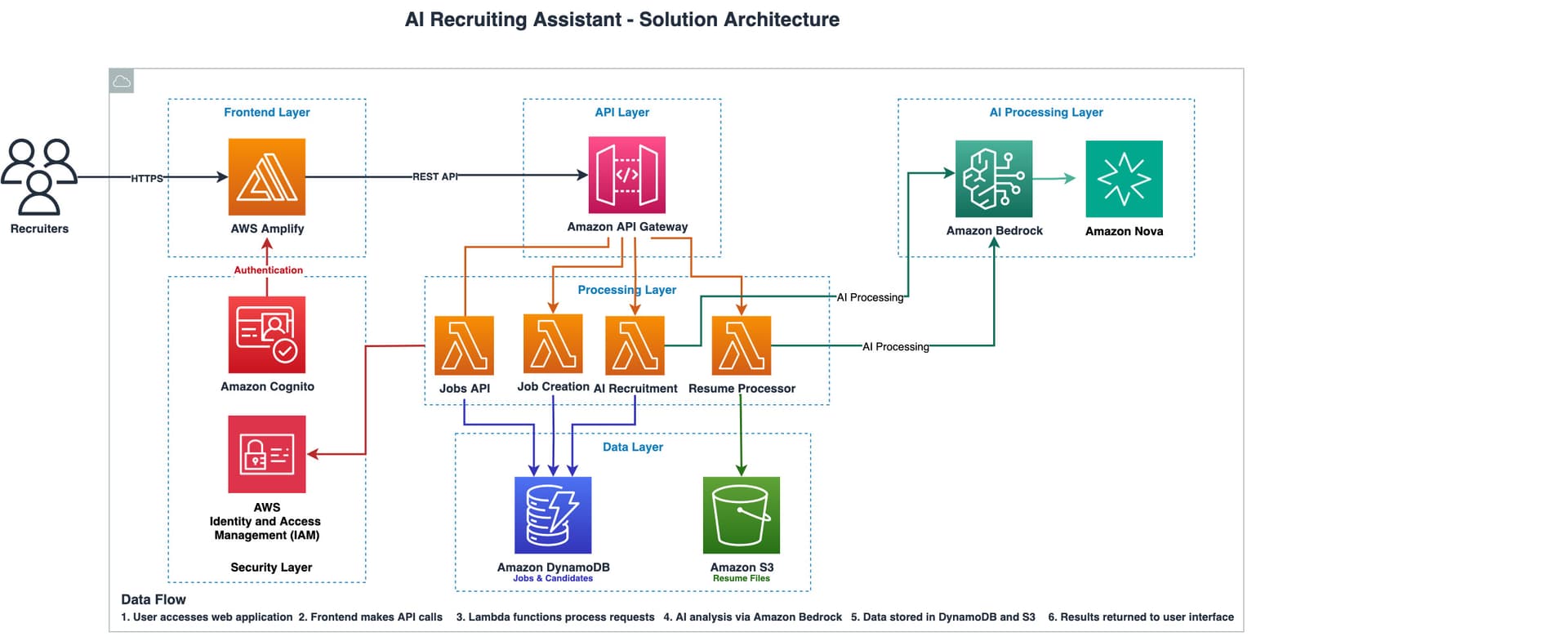
AWS published a reference architecture for building an AI-powered recruitment assistant using Amazon Bedrock that automates resume parsing, candidate scoring, skill assessment, and interview question generation. The solution addresses a documented problem where recruiters spend an average of 17.7 hours per vacancy on administrative work, with 45% of talent acquisition leaders spending more than half their time on automatable tasks. The system incorporates Amazon Bedrock Guardrails for PII anonymization, bias filtering, and prompt attack detection across a serverless architecture combining Lambda, API Gateway, DynamoDB, and S3.
TL;DR
- Recruiters waste 17.7 hours per hire on admin work, with 45% of TA leaders spending over half their time on automatable tasks
- AWS demonstrated a reference architecture using Bedrock, Nova Pro, Lambda, and Guardrails for resume analysis, candidate scoring, and interview prep
- Solution includes PII anonymization, bias-related content filtering, and prompt attack detection through Bedrock Guardrails
- Architecture uses API Gateway for routing, DynamoDB and S3 for storage, and Amplify with Cognito for authentication
Why It Matters
Recruitment teams face significant efficiency losses due to administrative overhead that prevents thorough candidate evaluation. This reference architecture demonstrates how foundation models can redirect recruiter time from manual screening toward higher-value hiring decisions while incorporating responsible AI safeguards like bias detection and PII protection.
Business Impact
Organizations can reduce time-to-hire and improve candidate quality by automating resume screening and interview preparation. The architecture provides a template for enterprises to build recruitment tools that maintain compliance and fairness while freeing talent teams to focus on relationship-building and strategic hiring decisions.
Key Implications
- Foundation models can meaningfully reduce administrative burden in talent acquisition when paired with proper guardrails for bias and privacy
- Responsible AI controls like PII anonymization and bias filtering are becoming standard expectations in HR-facing AI tools
- Serverless architectures enable rapid deployment of specialized AI workflows without requiring dedicated infrastructure investment
What to Watch
Monitor adoption patterns of similar recruitment AI tools to understand whether organizations prioritize time savings or candidate quality improvements. Watch for regulatory developments around AI use in hiring, particularly regarding bias detection and transparency requirements that may affect how these systems are deployed in production environments.
Subscribe to the newsletter
The latest stories and analysis, delivered to your inbox.
Free. No spam. Unsubscribe any time.


