VFF - The signal in the noise
NewsTrending

Google Launches Faster, More Secure TPU Chips to Challenge Nvidia
Read original
Share
Google Launches Faster, More Secure TPU Chips to Challenge Nvidia

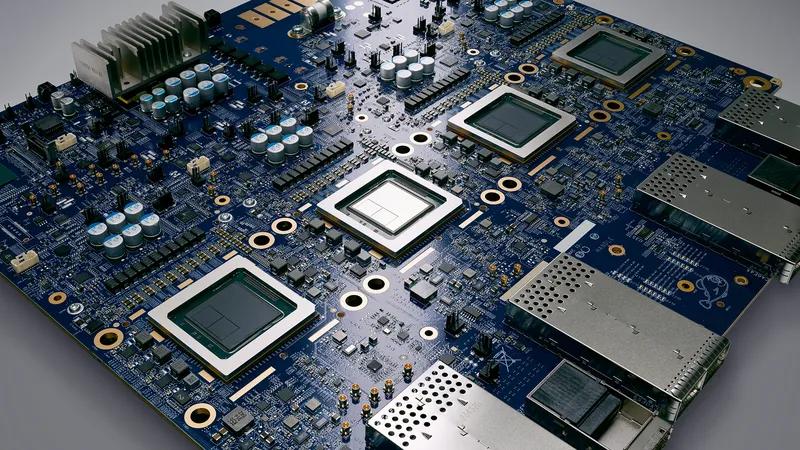
Google announced two new tensor processing units, the TPU 8tx and TPU 8i Max, designed to handle heavier AI workloads with improved security compared to previous generations. The chips represent an expansion of Google's growing chip business and pose a competitive challenge to Nvidia's dominance in the AI hardware market. The announcement underscores a broader industry shift toward custom silicon for AI applications.

  • Google launched TPU 8tx and TPU 8i Max chips with enhanced security features
  • New TPUs are designed for heavier workloads than previous generations
  • Move expands Google's chip business and challenges Nvidia's market position
  • Part of broader trend of tech companies developing custom AI silicon

Custom AI chips are becoming central to competitive advantage in the AI era. Google's ability to design and deploy proprietary hardware gives it cost and performance advantages over competitors relying on third-party chips. This announcement signals Google's commitment to vertical integration in AI infrastructure.

For enterprises and cloud customers, Google's expanding TPU lineup offers alternative hardware options for AI workloads, potentially reducing dependence on Nvidia and creating pricing pressure across the market. Organizations evaluating cloud providers now have more granular hardware choices tied to specific workload requirements.

  • Nvidia faces intensifying competition from hyperscalers developing proprietary AI chips
  • Google strengthens its position as a full-stack AI infrastructure provider
  • Security improvements may become a key differentiator in AI hardware procurement decisions

Monitor adoption rates of the new TPUs among Google Cloud customers and whether other hyperscalers accelerate their own chip development programs. Track whether security features become a material factor in enterprise hardware selection and whether Nvidia responds with competitive announcements.

OneUpAI
OneUp Your Business. Get More Done. OneUp Your Business. Get More Done. OneUp Your Business. Get More Done.
Learn More
Share

Subscribe to the newsletter

The latest stories and analysis, delivered to your inbox.

Free. No spam. Unsubscribe any time.

Related stories

NVIDIA and Korea Deepen Sovereign AI Partnership
TrendingNews

NVIDIA and Korea Deepen Sovereign AI Partnership

NVIDIA and South Korea's Ministry of Science and ICT are expanding collaboration across the country's sovereign AI ecosystem, covering semiconductors, data center infrastructure, talent development, and security. The partnership includes training programs, hackathons, and technical seminars to strengthen GPU utilization, plus work with Korean foundation model builders using NVIDIA Dynamo software. NVIDIA also announced a separate collaboration with SK Telecom and Rebellions to advance sovereign AI infrastructure using NVIDIA NVLink Fusion technology.

by Jesse Clayton· NVIDIA Blog (AI)
NVIDIA Open Source Tools Drive AI-Native 6G Research
TrendingNews

NVIDIA Open Source Tools Drive AI-Native 6G Research

NVIDIA's open source wireless software tools, including Aerial and Sionna, have reached 1 million downloads and adoption across 8,000 research institutions as developers use them to build 6G networks. The tools enable researchers to test AI-driven approaches to wireless communications, including semantic communications for robotics, neural receivers for signal processing, and power management. Three concrete research projects demonstrate practical applications: King's College London reduced robot task completion time by up to 52.6% using semantic communications, SoftBank achieved 60% throughput gains with neural receivers, and ETH Zurich reduced block error rates by one-third through localized receiver tuning.

by Soma Velayutham· NVIDIA Blog (AI)
TSMC Eyes Advanced Memory Chips to Deepen AI Supply Chain Control

TSMC Eyes Advanced Memory Chips to Deepen AI Supply Chain Control

TSMC is planning to manufacture advanced 3D DRAM memory chips at Nvidia's request, marking a potential expansion into memory production for the chipmaker. The move responds to severe memory chip shortages driven by AI hardware demand, which has pushed prices higher and prompted major chip designers to seek additional supply sources. Apple has already raised device prices citing rising memory costs. This would consolidate more of the AI hardware supply chain under TSMC's control.

by Qianer Liu· The Information
NVIDIA Vera CPU Targets AI Agent Bottleneck with Speed and Efficiency
TrendingModel Release

NVIDIA Vera CPU Targets AI Agent Bottleneck with Speed and Efficiency

NVIDIA has released Vera, a CPU designed to handle AI agent workloads that require both fast execution and high capacity. The chip delivers faster agent performance than the fastest x86 CPUs while also supporting 1.6x more agents per watt than comparable processors. Early adopters including Perplexity, DeepInfra, and Modal report performance gains ranging from 1.5x to 2.2x on production agent tasks.

by Hannah Coutand· NVIDIA Blog (AI)