AWS Releases 38 Open-Source Skills to Fix AI Agent Reasoning in Healthcare
AWS released 38 open-source agent skills across 11 healthcare and life sciences domains to fix a critical failure mode in AI agents: they cite correct frameworks but misapply them in practice, leading to silent errors in variant interpretation, claims processing, and clinical workflows. The skills encode structured decision procedures as markdown documents that agents consume at inference time, improving head-to-head performance by 70-86 percent and critical thinking by 78-85 percent. All skills are released under MIT-0 license and available on GitHub.
TL;DR
- AWS published 38 open-source agent skills for healthcare and life sciences, addressing silent failures where AI agents misapply domain frameworks despite knowing the facts
- Skills encode decision procedures, parameter tables, and validation criteria as structured markdown, distinct from RAG or fine-tuning approaches
- Agents equipped with skills won 70-86 percent of head-to-head comparisons against unskilled agents, with strongest gains in critical thinking (78-85 percent win rate)
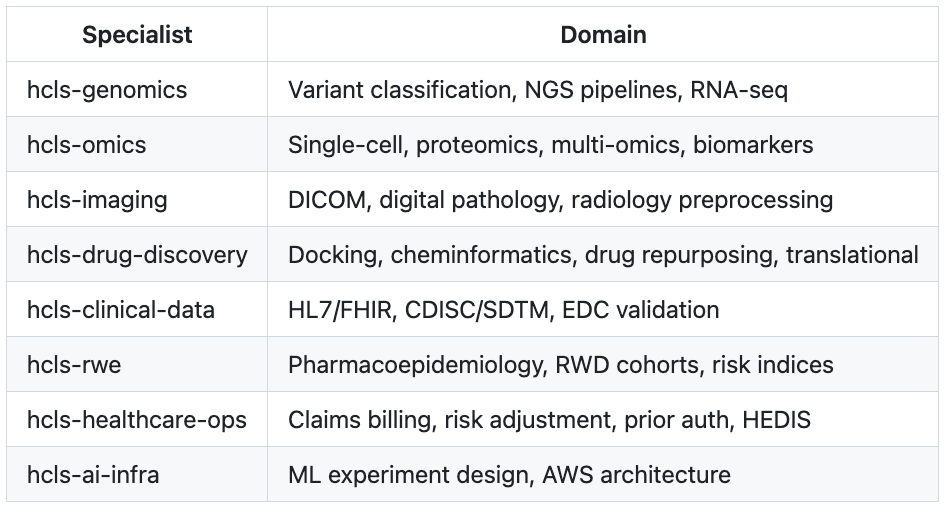
- Skills cover 11 domains including genomics, drug discovery, claims operations, and medical imaging, released under MIT-0 license
Why It Matters
Foundation models in healthcare often produce outputs that appear correct but apply wrong criteria, creating regulatory and patient safety risks. This gap between factual knowledge and procedural reasoning is a known failure mode in high-stakes domains. Encoding decision frameworks as auditable, portable skills offers a practical path to close that gap without retraining models.
Business Impact
Healthcare organizations deploying AI agents face liability and compliance risk when agents misapply clinical or regulatory frameworks. Open-source skills reduce development time and risk by providing validated decision procedures for common HCLS workflows, lowering the cost of building trustworthy agentic systems.
Key Implications
- Silent failures in AI-assisted healthcare decisions may be more common than detected, suggesting broader need for structured reasoning approaches in regulated domains
- Open-source skill libraries could become standard infrastructure for domain-specific AI deployment, similar to how libraries and frameworks work in software engineering
- Measurable performance gains (70-86 percent) suggest structured prompting and procedural encoding are viable alternatives to fine-tuning for domain specialization in agents
What to Watch
Monitor adoption of these skills in production healthcare systems and whether similar skill collections emerge in other regulated domains (finance, legal, pharma). Watch for evidence of whether skills reduce actual errors in clinical workflows or if they primarily improve benchmark performance. Track whether the open-source model sustains community contributions or remains AWS-driven.
Subscribe to the newsletter
The latest stories and analysis, delivered to your inbox.
Free. No spam. Unsubscribe any time.


