AWS Quick Now Integrates Atlassian Confluence for Unified Documentation Search
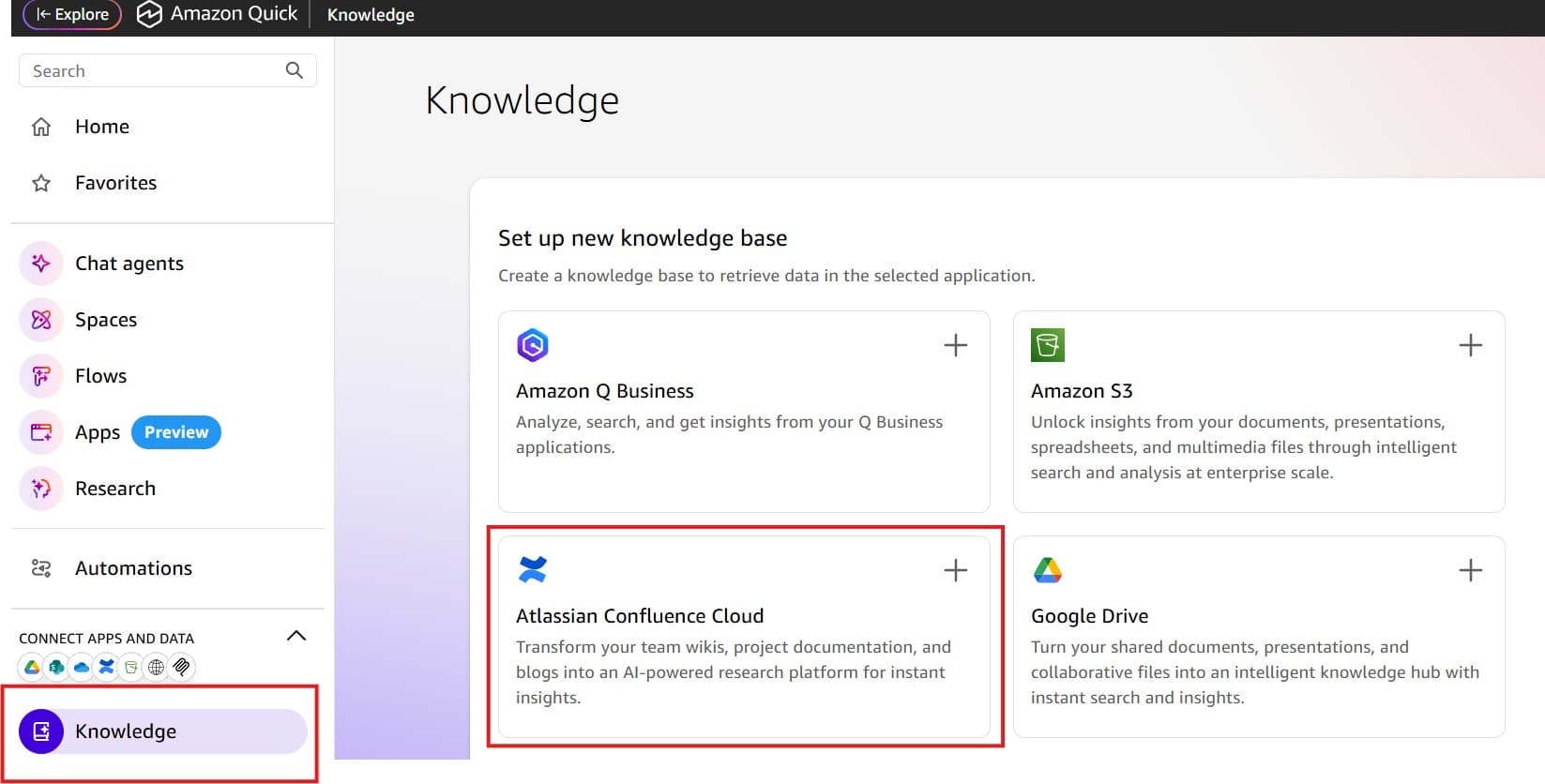
AWS has released integration capabilities between Atlassian Confluence Cloud and Amazon Quick, allowing teams to search and manage documentation through natural language queries without switching between systems. The integration works through two complementary approaches: Actions that execute tasks in real time across connected applications, and Knowledge bases that pre-index Confluence content for instant semantic search. Teams can now query Confluence pages, retrieve documentation, and update content while accessing data from other integrated systems like Amazon S3, JIRA, and Redshift.
TL;DR
- Amazon Quick now integrates directly with Atlassian Confluence Cloud via built-in connectors, REST APIs, or Model Context Protocol servers
- Actions enable real-time read, write, and task automation across Confluence and other enterprise systems without leaving Quick
- Knowledge bases pre-index Confluence documents and wikis to make unstructured content instantly searchable through natural language queries
- Integration reduces context switching and manual information gathering by consolidating documentation access with other business data sources
Why It Matters
This integration addresses a core friction point in enterprise AI adoption: the fragmentation of knowledge across disconnected systems. By making Confluence content queryable through natural language within Quick, AWS is reducing the operational overhead that slows decision-making and limits the practical utility of AI assistants in knowledge-heavy organizations. The dual approach of Actions and Knowledge bases provides flexibility for different use cases, from real-time task execution to semantic search over static documentation.
Business Impact
For teams using Confluence as a central knowledge repository, this integration eliminates the productivity tax of context switching between documentation and other business systems. Operators can now deploy AI assistants that have immediate access to internal documentation, reducing onboarding time and enabling faster problem-solving. The ability to both search and update Confluence content through Quick creates a more cohesive workflow for knowledge management and operational automation.
Key Implications
- Enterprise AI assistants are becoming more viable as integrations with existing knowledge systems improve, reducing the need to migrate or duplicate content
- The availability of multiple integration paths (built-in connectors, REST APIs, MCP servers) signals AWS is building a flexible ecosystem rather than forcing a single integration model
- Pre-indexed knowledge bases represent a practical middle ground between real-time API calls and static embeddings, optimizing for both freshness and query speed
What to Watch
Monitor whether other documentation platforms (Notion, SharePoint, GitBook) receive similar Quick integrations, as this would indicate a broader shift toward making AI assistants documentation-aware by default. Watch for adoption patterns to see whether teams prefer real-time Actions or pre-indexed Knowledge bases for different content types, as this could inform how other vendors approach enterprise AI integration.
Subscribe to the newsletter
The latest stories and analysis, delivered to your inbox.
Free. No spam. Unsubscribe any time.