Bedrock AgentCore Adds Code-Based Evaluators for Production Agents
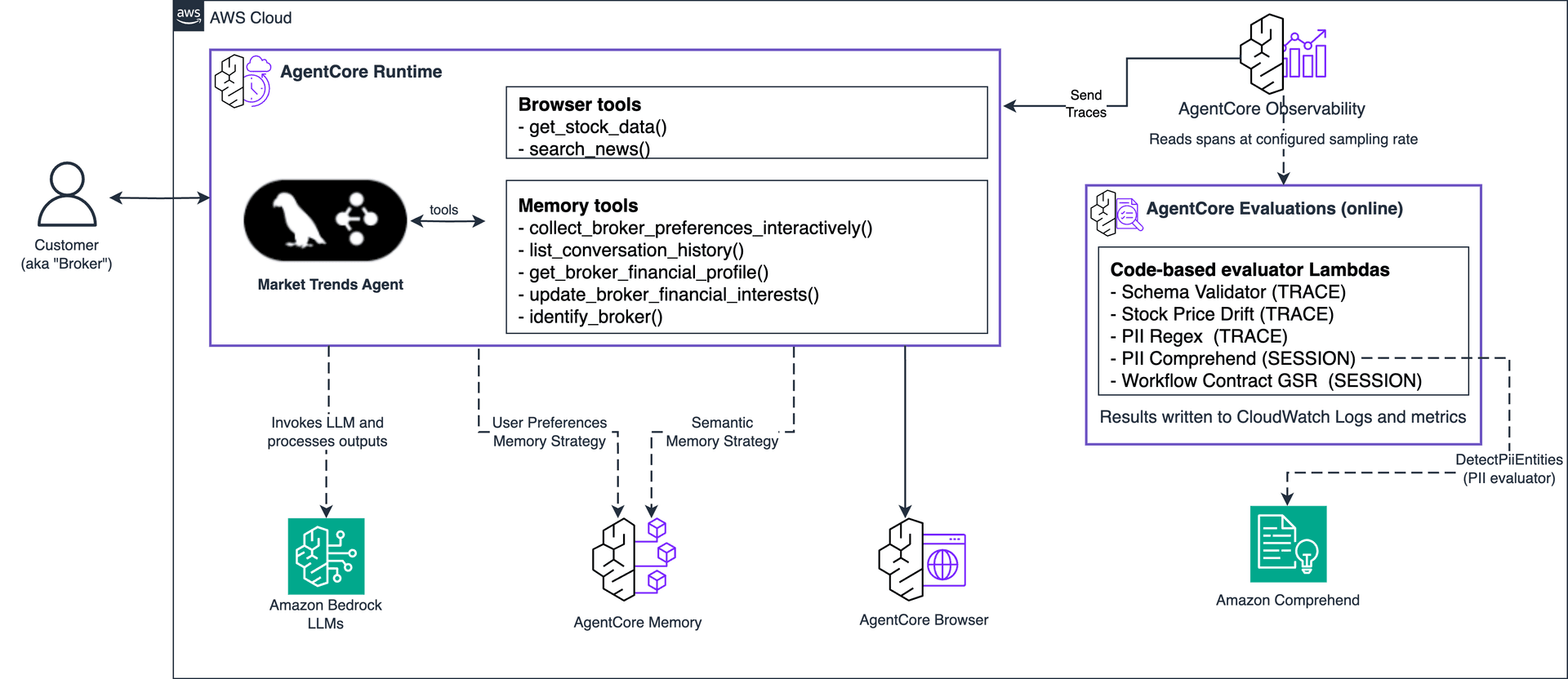
Amazon Bedrock AgentCore now supports custom code-based evaluators built on AWS Lambda, allowing developers to assess agentic applications using deterministic logic rather than LLM-as-a-Judge checks. The feature targets production-grade quality assurance for agents in regulated domains like financial services, where requirements include schema validation, numerical accuracy checks, workflow compliance, and PII detection. Code-based evaluators can run in on-demand evaluation workflows and online production monitoring, and can be combined with built-in LLM evaluators for comprehensive quality assessment.
TL;DR
- Amazon Bedrock AgentCore adds custom code-based evaluators using AWS Lambda functions for deterministic agent quality checks
- Designed for domain-specific requirements in financial services and regulated industries, including schema validation, price accuracy, workflow compliance, and PII detection
- Code-based evaluators avoid LLM token costs for objective checks and work across different agent frameworks with consistent logic
- Evaluators support both on-demand CI/CD pipeline gates and online production traffic scoring, with integration to other AWS services for fact-checking and alerting
Why It Matters
As agents move from prototypes to production, quality assurance becomes critical, especially in regulated domains where deterministic checks are more reliable and cost-effective than LLM judgment. This feature addresses a real gap: LLMs are prone to arithmetic errors and hallucinations, while code-based validation can enforce hard constraints like schema compliance and numerical accuracy that directly impact business outcomes. The ability to combine code-based and LLM evaluators gives teams flexibility to apply the right tool for each quality dimension.
Business Impact
For financial services and other regulated industries, this reduces the cost and latency of quality assurance by replacing expensive LLM calls with deterministic code for objective checks like price validation and workflow enforcement. Teams can now gate deployments on measurable, reproducible criteria and monitor production agents in real time without incurring per-request LLM costs. This makes it practical to run continuous evaluation on live traffic and catch data quality issues before they propagate to users.
Key Implications
- Code-based evaluators lower the operational cost of agent monitoring in production by eliminating LLM token consumption for deterministic checks, making continuous evaluation economically viable
- Deterministic validation catches structural and numerical errors that LLMs frequently miss, improving reliability in high-stakes domains like financial trading and compliance workflows
- The ability to use custom Lambda logic across different agent frameworks creates a standardized evaluation layer that is framework-agnostic and reusable across multiple applications
What to Watch
Monitor adoption patterns in financial services and regulated industries to see whether code-based evaluators become the standard for production agent quality gates. Watch for ecosystem tooling that simplifies writing and managing Lambda-based evaluators, and whether AWS expands this pattern to other evaluation dimensions or other agent platforms. Also track whether competitors like Anthropic or Google add similar deterministic evaluation capabilities to their agent offerings.
Subscribe to the newsletter
The latest stories and analysis, delivered to your inbox.
Free. No spam. Unsubscribe any time.