vff — the signal in the noise
News

Bedrock AgentCore adds Chrome policies for controlled agent browsing
Sundar RaghavanRead original
Share
Bedrock AgentCore adds Chrome policies for controlled agent browsing

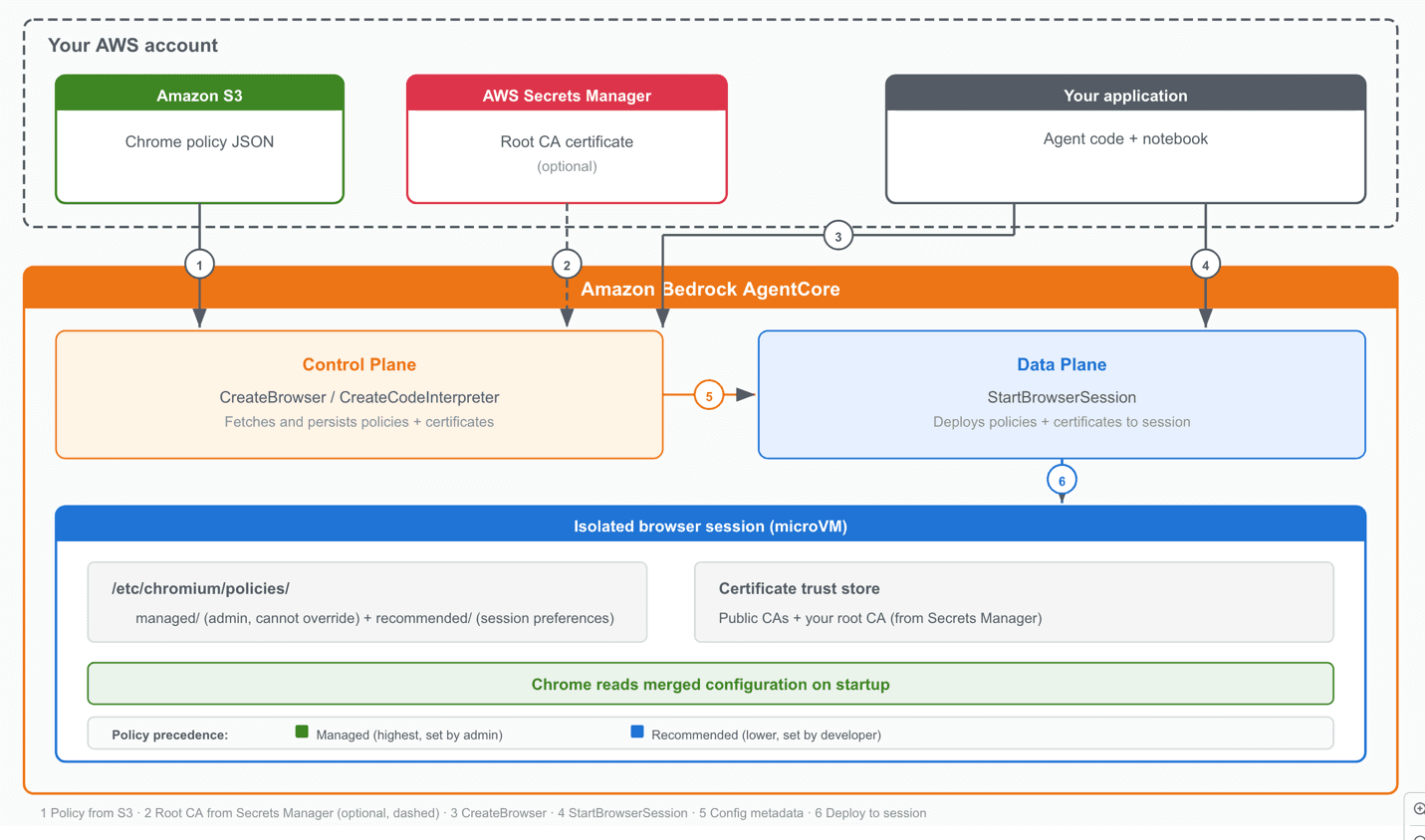
Amazon Bedrock AgentCore now supports Chrome enterprise policies and custom root CA certificates, enabling organizations to enforce granular browser controls on AI agents. The feature allows configuration of over 450 browser settings including URL filtering, download restrictions, and password manager controls through familiar Chrome enterprise JSON configuration. Custom root CA support lets agents connect to internal services and work with corporate SSL-intercepting proxies. This addresses security risks from unrestricted web access and certificate validation failures on private infrastructure.

TL;DR

  • Bedrock AgentCore Browser now enforces Chrome enterprise policies with 450+ configurable settings
  • URL allowlists and denylists restrict agent navigation to approved domains independent of prompt engineering
  • Custom root CA certificates enable agents to connect to internal services and corporate proxies
  • Policies are managed at the browser level through the control plane API, separating security governance from agent development

Why it matters

As AI agents gain web access capabilities, unrestricted browsing creates security and compliance risks. This feature brings enterprise-grade browser controls to agent deployments, addressing a critical gap between agent flexibility and organizational security requirements. The separation of policy management from agent logic also enables security teams and development teams to operate independently.

Business relevance

Organizations deploying agents for sensitive tasks like invoice processing or data entry can now enforce browser restrictions without embedding policy logic into agent code. This reduces operational overhead, improves security posture, and enables faster iteration on agent capabilities while maintaining compliance boundaries.

Key implications

  • Enterprise adoption of web-capable agents becomes more viable for regulated industries and organizations with strict security requirements
  • Security teams gain a familiar control surface through Chrome enterprise policies rather than requiring custom agent-level restrictions
  • Internal service integration becomes practical for agents, expanding use cases beyond public web access to proprietary systems and APIs

What to watch

Monitor adoption patterns to see whether enterprises prioritize URL filtering, credential management controls, or certificate handling. Watch for emerging best practices around policy templates and whether AWS or third parties develop standardized policy libraries for common agent use cases. Also track whether other agent platforms adopt similar enterprise policy frameworks.

Share

vff Briefing

Weekly signal. No noise. Built for founders, operators, and AI-curious professionals.

No spam. Unsubscribe any time.

Related stories

AI Discovers Security Flaws Faster Than Humans Can Patch Them

AI Discovers Security Flaws Faster Than Humans Can Patch Them

Recent high-profile breaches at startups like Mercor and Vercel, combined with Anthropic's disclosure that its Mythos AI model identified thousands of previously unknown cybersecurity vulnerabilities, underscore growing demand for AI-powered security solutions. The article argues that cybersecurity vendors CrowdStrike and Palo Alto Networks, which are integrating AI into their threat detection and response capabilities, represent undervalued investment opportunities as enterprises face mounting pressure to defend against both conventional and AI-discovered attack vectors.

16 days ago· The Information
AWS Launches G7e GPU Instances for Cheaper Large Model Inference
TrendingModel Release

AWS Launches G7e GPU Instances for Cheaper Large Model Inference

AWS has launched G7e instances on Amazon SageMaker AI, powered by NVIDIA RTX PRO 6000 Blackwell GPUs with 96 GB of GDDR7 memory per GPU. The instances deliver up to 2.3x inference performance compared to previous-generation G6e instances and support configurations from 1 to 8 GPUs, enabling deployment of large language models up to 300B parameters on the largest 8-GPU node. This represents a significant upgrade in memory bandwidth, networking throughput, and model capacity for generative AI inference workloads.

24 days ago· AWS Machine Learning Blog
Anthropic Launches Claude Design for Non-Designers
Model Release

Anthropic Launches Claude Design for Non-Designers

Anthropic has launched Claude Design, a new product aimed at helping non-designers like founders and product managers create visuals quickly to communicate their ideas. The tool addresses a gap for early-stage teams and individuals who need to share concepts visually but lack design expertise or resources. Claude Design integrates with Anthropic's Claude AI platform, leveraging its capabilities to streamline the visual creation process. The launch reflects growing demand for AI-powered design tools that lower barriers to entry for non-technical users.

25 days ago· TechCrunch AI
Huang Foundation Rents Nvidia GPUs From CoreWeave for AI Developer Donations

Huang Foundation Rents Nvidia GPUs From CoreWeave for AI Developer Donations

The Huang Foundation, the charitable organization of Nvidia CEO Jensen Huang and his wife Lori, has signed a deal to rent Nvidia GPUs from CoreWeave with the intention of donating them to AI developers. The arrangement, disclosed in Nvidia's annual report, represents a structured approach to philanthropic GPU distribution in the AI ecosystem. The foundation has already committed $108 million toward this initiative, signaling a significant capital allocation toward supporting AI research and development outside Nvidia's direct commercial channels.

2 days ago· The Information