vff — the signal in the noise
News

AWS, Databricks Show How to Fine-Tune LLMs Without Bypassing Data Governance
Genta WatanabeRead original
Share
AWS, Databricks Show How to Fine-Tune LLMs Without Bypassing Data Governance

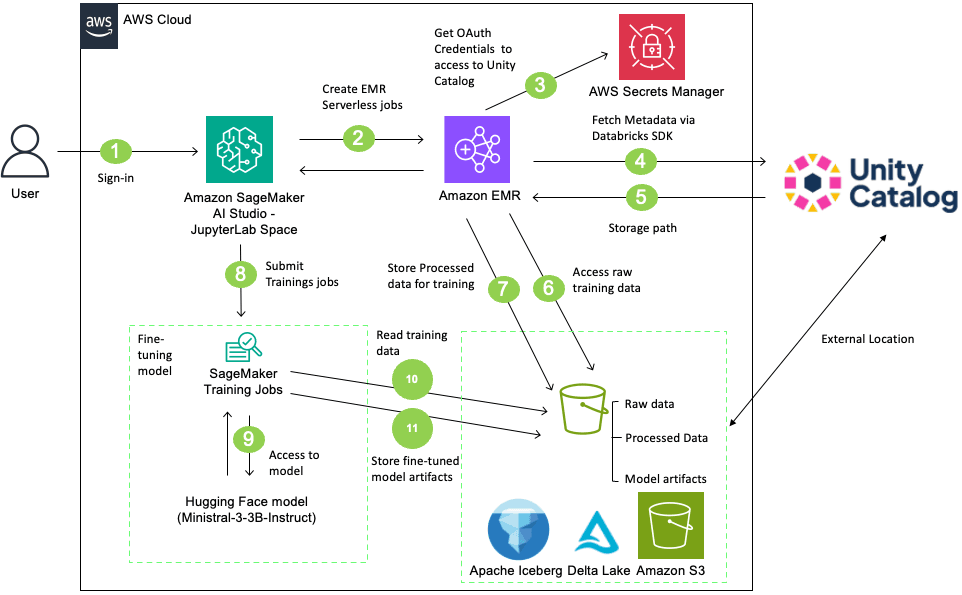
AWS and Databricks have published a reference architecture for fine-tuning large language models while maintaining data governance through Databricks Unity Catalog. The workflow integrates SageMaker AI Training with Unity Catalog's permission controls, uses Amazon EMR Serverless for data preprocessing, and tracks lineage from source data through model artifacts. This addresses a real compliance gap: without structured integration, SageMaker jobs can bypass Unity Catalog's authorization model when accessing S3 data, creating audit and regulatory exposure in production environments.

TL;DR

  • AWS published a reference implementation for fine-tuning LLMs with SageMaker AI while preserving Databricks Unity Catalog governance controls
  • The solution uses EMR Serverless for Spark-based preprocessing and maintains data lineage tracking across the entire workflow
  • Key problem solved: SageMaker Training jobs can inadvertently bypass Unity Catalog's fine-grained authorization, creating compliance and audit gaps
  • Demonstrates fine-tuning of Ministral-3-3B-Instruct model with proper data governance for regulated industries and production workloads

Why it matters

As enterprises adopt multi-cloud ML stacks, governance gaps between data platforms and training services create real compliance risk. This pattern shows how to maintain centralized data governance while using best-in-class ML services, which is critical for regulated industries where audit trails and permission enforcement cannot be bypassed or circumvented.

Business relevance

For operators running production ML workloads, this solves a concrete operational problem: how to fine-tune models without losing visibility into which data trained which models or creating compliance exposure. Teams using both Databricks and AWS can now integrate these services without choosing between governance and capability.

Key implications

  • Structured integration patterns between data governance platforms and ML training services are becoming table stakes for enterprise adoption
  • Data lineage tracking across heterogeneous services is moving from nice-to-have to compliance requirement in regulated industries
  • The reference architecture suggests AWS and Databricks are positioning their services as complementary rather than competitive in the ML stack

What to watch

Monitor whether this pattern becomes a standard practice across other cloud providers and whether similar integrations emerge for other governance platforms. Watch for adoption signals in regulated industries like finance and healthcare, where compliance requirements drive architectural decisions.

Share

vff Briefing

Weekly signal. No noise. Built for founders, operators, and AI-curious professionals.

No spam. Unsubscribe any time.

Related stories

AI Discovers Security Flaws Faster Than Humans Can Patch Them

AI Discovers Security Flaws Faster Than Humans Can Patch Them

Recent high-profile breaches at startups like Mercor and Vercel, combined with Anthropic's disclosure that its Mythos AI model identified thousands of previously unknown cybersecurity vulnerabilities, underscore growing demand for AI-powered security solutions. The article argues that cybersecurity vendors CrowdStrike and Palo Alto Networks, which are integrating AI into their threat detection and response capabilities, represent undervalued investment opportunities as enterprises face mounting pressure to defend against both conventional and AI-discovered attack vectors.

16 days ago· The Information
AWS Launches G7e GPU Instances for Cheaper Large Model Inference
TrendingModel Release

AWS Launches G7e GPU Instances for Cheaper Large Model Inference

AWS has launched G7e instances on Amazon SageMaker AI, powered by NVIDIA RTX PRO 6000 Blackwell GPUs with 96 GB of GDDR7 memory per GPU. The instances deliver up to 2.3x inference performance compared to previous-generation G6e instances and support configurations from 1 to 8 GPUs, enabling deployment of large language models up to 300B parameters on the largest 8-GPU node. This represents a significant upgrade in memory bandwidth, networking throughput, and model capacity for generative AI inference workloads.

24 days ago· AWS Machine Learning Blog
Anthropic Launches Claude Design for Non-Designers
Model Release

Anthropic Launches Claude Design for Non-Designers

Anthropic has launched Claude Design, a new product aimed at helping non-designers like founders and product managers create visuals quickly to communicate their ideas. The tool addresses a gap for early-stage teams and individuals who need to share concepts visually but lack design expertise or resources. Claude Design integrates with Anthropic's Claude AI platform, leveraging its capabilities to streamline the visual creation process. The launch reflects growing demand for AI-powered design tools that lower barriers to entry for non-technical users.

25 days ago· TechCrunch AI
Huang Foundation Rents Nvidia GPUs From CoreWeave for AI Developer Donations

Huang Foundation Rents Nvidia GPUs From CoreWeave for AI Developer Donations

The Huang Foundation, the charitable organization of Nvidia CEO Jensen Huang and his wife Lori, has signed a deal to rent Nvidia GPUs from CoreWeave with the intention of donating them to AI developers. The arrangement, disclosed in Nvidia's annual report, represents a structured approach to philanthropic GPU distribution in the AI ecosystem. The foundation has already committed $108 million toward this initiative, signaling a significant capital allocation toward supporting AI research and development outside Nvidia's direct commercial channels.

2 days ago· The Information