GAN Synthesizes Missing Brain MRI Scans While Preserving Tumors
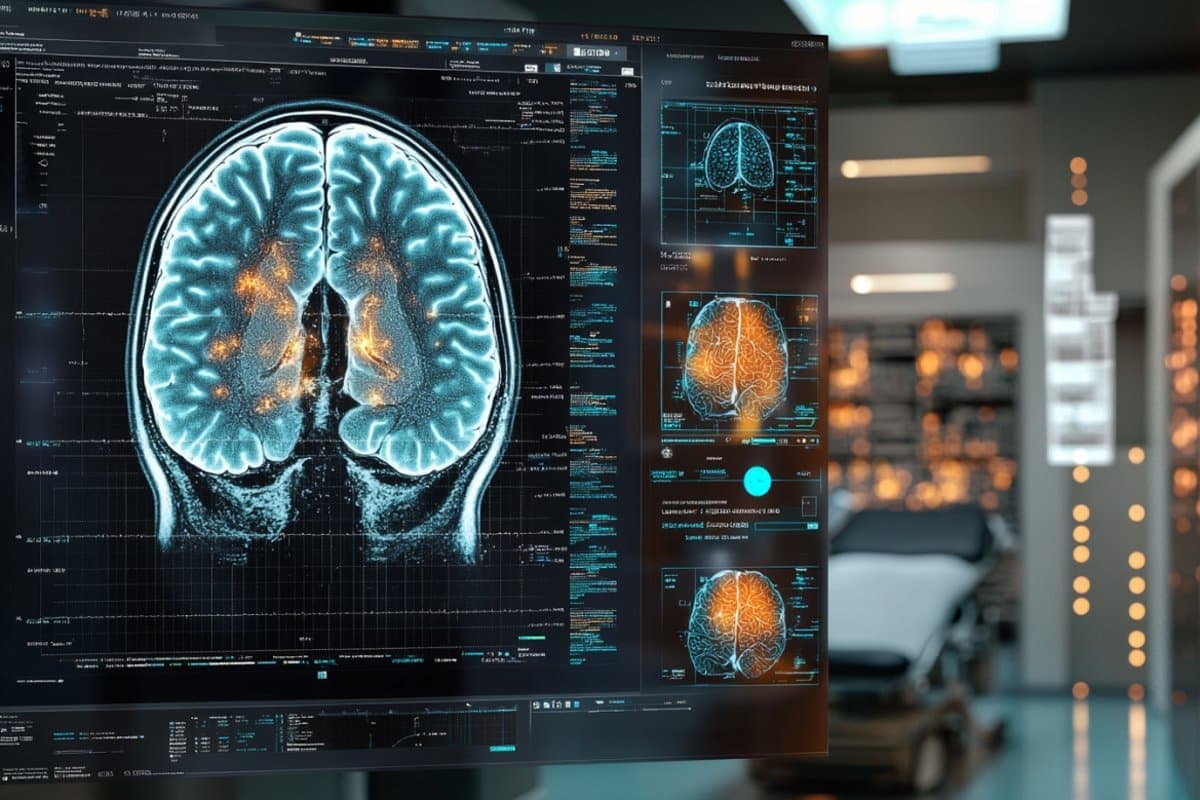
Researchers propose 3D-MC-SAGAN, a generative model that synthesizes missing MRI brain scan modalities from a single T2-weighted input while preserving tumor characteristics. The approach uses a 3D encoder-decoder generator with a novel Memory-Bounded Hybrid Attention block and enforces tumor consistency through a frozen segmentation network during training. Experiments show the method achieves state-of-the-art synthesis quality and maintains tumor segmentation accuracy comparable to fully acquired multi-modal scans, potentially reducing patient scan time and cost in neuro-oncological assessment.
TL;DR
- 3D-MC-SAGAN generates missing MRI contrasts (T2f, T1n, T1c) from single T2w input using a unified 3D GAN framework with residual connections and Memory-Bounded Hybrid Attention blocks
- Model incorporates frozen 3D U-Net segmentation network to enforce tumor-consistency constraints during training, ensuring pathological fidelity alongside anatomical realism
- Composite loss function combines adversarial, reconstruction, perceptual, structural similarity, contrast-classification, and segmentation-guided objectives to balance global realism with tumor preservation
- Achieves tumor segmentation accuracy comparable to fully acquired multi-modal inputs, suggesting potential to reduce acquisition burden without sacrificing clinical utility
Why It Matters
Medical imaging synthesis is a high-stakes application where generative models must balance realism with clinical fidelity. This work demonstrates that careful architectural choices, constraint enforcement, and multi-objective training can produce synthetic modalities that preserve critical diagnostic information, advancing the feasibility of using GANs in clinical workflows where missing data is common.
Business Impact
Reducing MRI acquisition time and cost while maintaining diagnostic accuracy has direct economic value for hospitals and imaging centers. A validated synthesis approach could lower patient burden, improve throughput, and reduce operational costs, making it commercially relevant for medical imaging software vendors and healthcare providers.
Key Implications
- Constraint-based training through frozen segmentation networks offers a reusable pattern for ensuring domain-specific fidelity in generative models beyond medical imaging
- Multi-objective loss design combining adversarial, reconstruction, and task-specific guidance may become standard practice for high-stakes synthesis tasks where both perceptual quality and functional accuracy matter
- Successful tumor preservation in synthetic modalities suggests generative models can be trusted for clinical decision support if properly validated, potentially accelerating adoption in regulated healthcare settings
What to Watch
Monitor whether this approach generalizes to other tumor types, imaging protocols, and patient populations in follow-up studies. Watch for clinical validation efforts and regulatory pathway exploration, as real-world deployment would require demonstrating that synthetic modalities do not degrade diagnostic outcomes in prospective studies.
Subscribe to the newsletter
The latest stories and analysis, delivered to your inbox.
Free. No spam. Unsubscribe any time.