Amazon Bedrock Formalizes Model Lifecycle with Extended Access
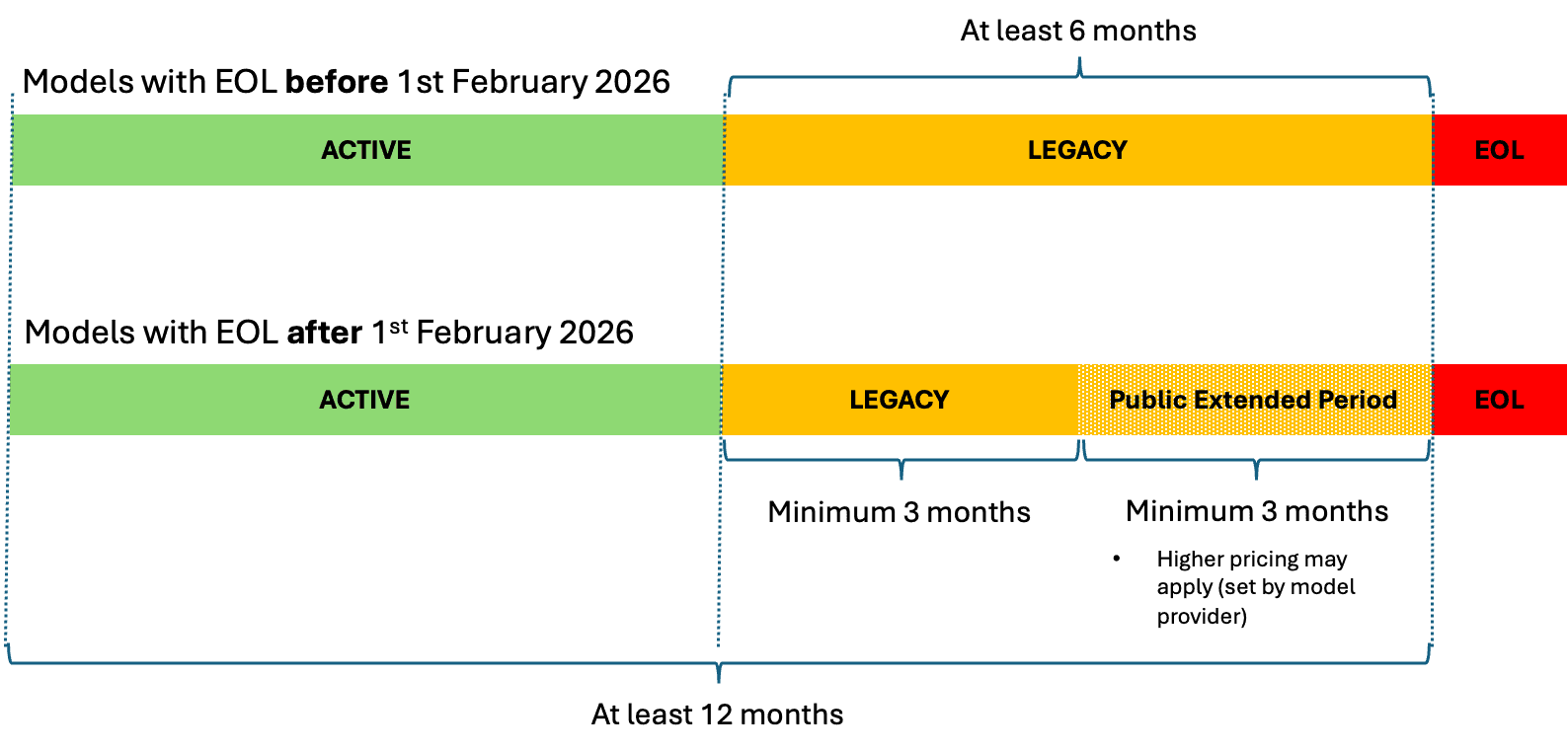
Amazon Bedrock has formalized a model lifecycle management framework with three states: Active, Legacy, and End-of-Life. Models transition through these states with at least 6 months' advance notice before EOL, and new models with EOL dates after February 1, 2026 include an extended access period allowing continued use for at least 3 additional months after the Legacy phase. The framework lets developers test new model versions before migration and provides tools to manage transitions without disrupting production applications.
TL;DR
- →Amazon Bedrock models exist in three lifecycle states: Active (ongoing maintenance and updates), Legacy (6+ months notice before EOL), and End-of-Life (model no longer available)
- →New models with EOL dates after February 1, 2026 include a public extended access period within Legacy status, allowing at least 3 additional months of use after the initial 3-month Legacy phase
- →Existing customers can continue using Legacy models, but new customers may lose access, and inactive accounts lose access if they do not call the model for 15+ days
- →Developers can test new model versions through the Bedrock console or API before migration, and can request quota increases for Active models but not for Legacy or EOL models
Why it matters
Model lifecycle management is critical for production AI applications because unplanned model deprecations can force costly migrations under time pressure. By establishing a formal, transparent lifecycle with extended notice periods and extended access phases, AWS reduces operational risk for enterprises building on Bedrock and gives teams predictable windows to evaluate and migrate to newer models.
Business relevance
For operators and founders, this framework reduces the cost and complexity of maintaining AI applications at scale. The 6-month advance notice and extended access periods provide runway to test alternatives and plan migrations without emergency rewrites, while the ability to test new models before committing reduces the risk of adopting incompatible versions.
Key implications
- →Teams must monitor model lifecycle status via the Bedrock console or API and build migration planning into their development cycles, as Legacy models will eventually become unavailable
- →The 15-day inactivity threshold for losing access to Legacy models creates operational risk for applications with variable usage patterns, requiring monitoring and periodic invocations to maintain access
- →Extended access periods provide a safety net for migrations but are not indefinite, so applications cannot rely on Legacy models as a permanent fallback and must plan upgrades proactively
What to watch
Monitor AWS announcements for specific model EOL dates and track which models in your stack are approaching Legacy status. Watch for how the extended access period is adopted across Bedrock's model portfolio and whether AWS extends these timelines in response to customer feedback, as this will shape long-term planning for Bedrock-dependent applications.
vff Briefing
Weekly signal. No noise. Built for founders, operators, and AI-curious professionals.
No spam. Unsubscribe any time.