Ampersend and AWS Enable Autonomous Agent Payments
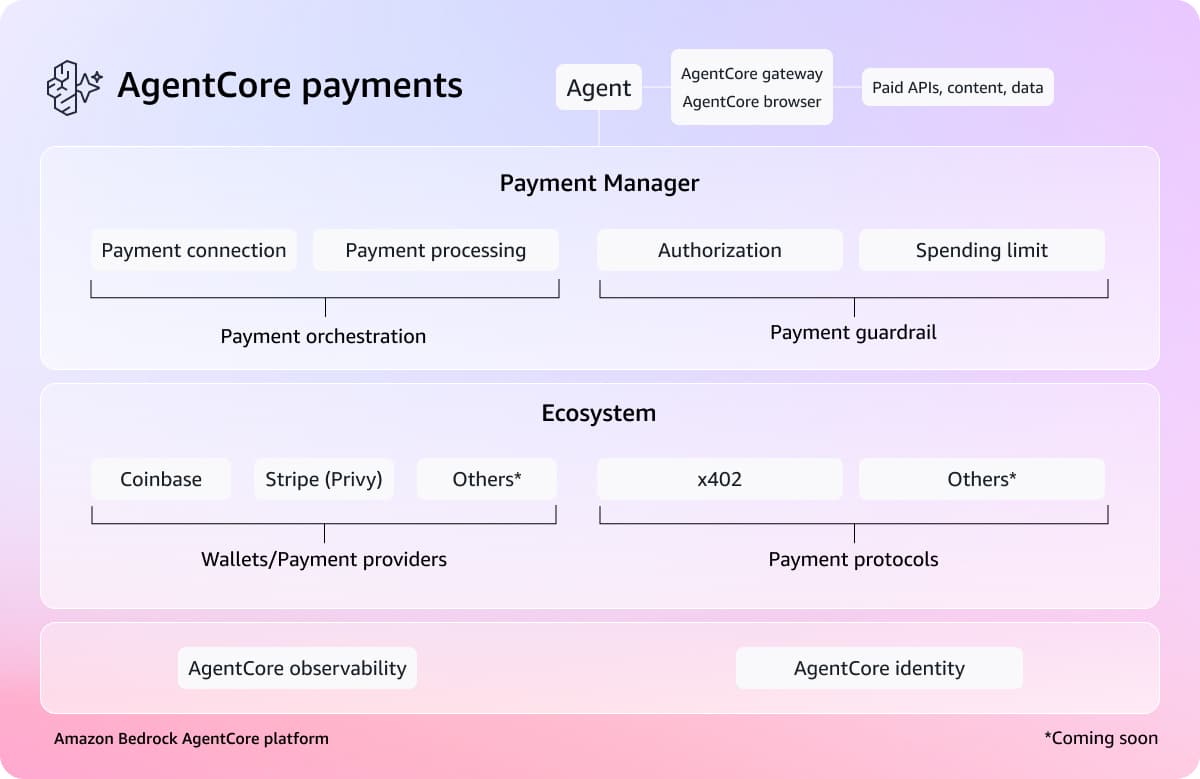
Ampersend, a platform for agent payments and operations, has built a pay-per-intelligence routing layer on top of Amazon Bedrock AgentCore Payments. The solution enables autonomous AI agents to route tasks to the most effective model, pay per request, and operate within spending budgets without developers building custom billing integrations. The platform uses the x402 open protocol to allow agents to transact programmatically and instantly across multiple model providers through a single integration point.
TL;DR
- Ampersend built a routing layer on Amazon Bedrock AgentCore Payments to enable autonomous agent payments across multiple model providers
- Agents can now route tasks to the most effective model, pay per request, and operate within governed spending limits
- The solution eliminates the need for developers to build custom wallet management, payment signing, and per-provider billing integrations
- The platform uses the x402 open protocol to enable programmatic, instant transactions without human intervention
Why It Matters
As AI agents become more autonomous, they need infrastructure to transact for services without manual intervention. Ampersend and Amazon Bedrock AgentCore Payments address a fundamental gap: agents currently cannot easily pay for intelligence services across multiple providers without months of custom infrastructure work. This solution standardizes how agents access and pay for AI services at scale.
Business Impact
Agent builders can now deploy autonomous systems without building custom payment infrastructure for each provider relationship. Service providers can reach agents through a single payment channel without managing individual billing relationships. This reduces time-to-market for agent applications and lowers operational overhead for both builders and providers.
Key Implications
- Agent builders can focus on agent logic rather than payment infrastructure, reducing development time and complexity
- A single integration point for agents to access multiple model providers could shift market dynamics away from per-provider subscriptions
- Standardized agentic payment protocols like x402 may become foundational infrastructure for autonomous AI systems
What to Watch
Monitor adoption of x402 and similar agentic payment protocols across the AI services ecosystem. Watch whether other cloud providers and payment platforms develop competing solutions. Track whether this model extends beyond LLMs to other paid AI services like data APIs and content endpoints.
Subscribe to the newsletter
The latest stories and analysis, delivered to your inbox.
Free. No spam. Unsubscribe any time.


