VFF - The signal in the noise
News

OpenAI Releases LifeSciBench for AI Evaluation
Read original
Share
OpenAI Releases LifeSciBench for AI Evaluation

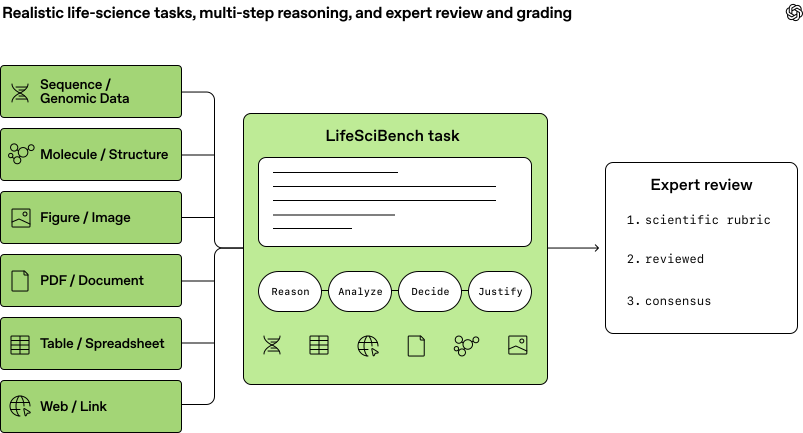
OpenAI has released LifeSciBench, a benchmark designed to evaluate how AI systems perform on real-world life science research tasks and decisions. The benchmark was authored and reviewed by experts in the field. It provides a standardized way to assess AI capabilities in scientific research contexts.

  • OpenAI introduced LifeSciBench, an expert-authored and expert-reviewed benchmark for evaluating AI systems
  • The benchmark focuses on real-world life science research tasks and decision-making
  • It provides a standardized evaluation framework for assessing AI performance in scientific contexts
  • The tool addresses the need for domain-specific benchmarks in life sciences

Benchmarking AI systems on domain-specific tasks is critical for understanding their real-world utility. Life sciences research involves complex decision-making and specialized knowledge, making it important to evaluate whether AI systems can handle these tasks reliably. LifeSciBench provides a structured way to measure this capability.

Organizations developing or deploying AI in life sciences research need reliable evaluation metrics to assess tool performance and safety. A standardized benchmark reduces uncertainty around AI capabilities in this high-stakes domain and helps guide investment and deployment decisions.

  • Establishes a reference standard for evaluating AI performance on life science tasks, enabling more consistent comparisons across different systems
  • Signals growing focus on domain-specific AI evaluation rather than relying solely on general-purpose benchmarks
  • May influence how life sciences organizations approach AI adoption and vendor selection

Monitor how widely LifeSciBench is adopted by AI developers and life sciences organizations. Track whether other AI labs release competing or complementary benchmarks for specialized domains. Watch for published results showing how different AI systems perform on the benchmark tasks.

Share

Subscribe to the newsletter

The latest stories and analysis, delivered to your inbox.

Free. No spam. Unsubscribe any time.

Related stories

Google DeepMind Researcher Shazeer Joins OpenAI

Google DeepMind Researcher Shazeer Joins OpenAI

Noam Shazeer, a key researcher behind Google's generative AI advances, is joining OpenAI. Shazeer had left Google in 2021 to co-found Character.AI, then rejoined Google DeepMind in 2024 as part of a $2.7 billion acquisition deal, where he became a tech lead on Gemini. His move to OpenAI represents a significant talent shift in the competitive AI research landscape.

by Amir Efrati· The Information
Stanford's Decentralized Agent Framework Cuts Costs 50%

Stanford's Decentralized Agent Framework Cuts Costs 50%

Stanford researchers have developed DeLM, a decentralized multi-agent framework that eliminates the need for a central orchestrator by allowing agents to coordinate directly through a shared knowledge base. The approach reduces inference costs by 50% compared to traditional centralized systems and addresses bottlenecks that occur when all agent communications must route through a main controller. The framework uses a shared context of verified findings, partial results, and documented failures that agents can access independently, along with a task queue that agents claim work from directly.

by taryn.plumb@venturebeat.com (Taryn Plumb)· VentureBeat AI
Sakana AI launches 8-hour research agent for enterprise strategy
TrendingNews

Sakana AI launches 8-hour research agent for enterprise strategy

Sakana AI, a Tokyo-based startup, launched Sakana Marlin, an autonomous research agent that generates 100-page strategy reports over 8 hours rather than seconds. The product targets enterprises, financial institutions, and think tanks with a pay-as-you-go pricing model. Marlin represents a shift in enterprise AI from speed-focused generation to deep, methodical reasoning using the company's Adaptive Branching Monte Carlo Tree Search technology.

by carl.franzen@venturebeat.com (Carl Franzen)· VentureBeat AI
Tencent Backs Alibaba's Former Qwen Researcher in $20M AI Lab Deal
TrendingNews

Tencent Backs Alibaba's Former Qwen Researcher in $20M AI Lab Deal

Tencent Holdings has invested $20 million in an AI lab founded by Junyang Lin, the former lead researcher behind Alibaba's Qwen models. Lin's new venture raised several hundred million dollars in its first funding round. The investment signals Tencent's interest in backing independent AI research talent and reflects ongoing competition among Chinese tech giants for AI expertise.

by Jing Yang· The Information