VFF - The signal in the noise
News

Bedrock AgentCore adds versioned datasets for stable agent evaluation
Visakh MadathilRead original
Share
Bedrock AgentCore adds versioned datasets for stable agent evaluation

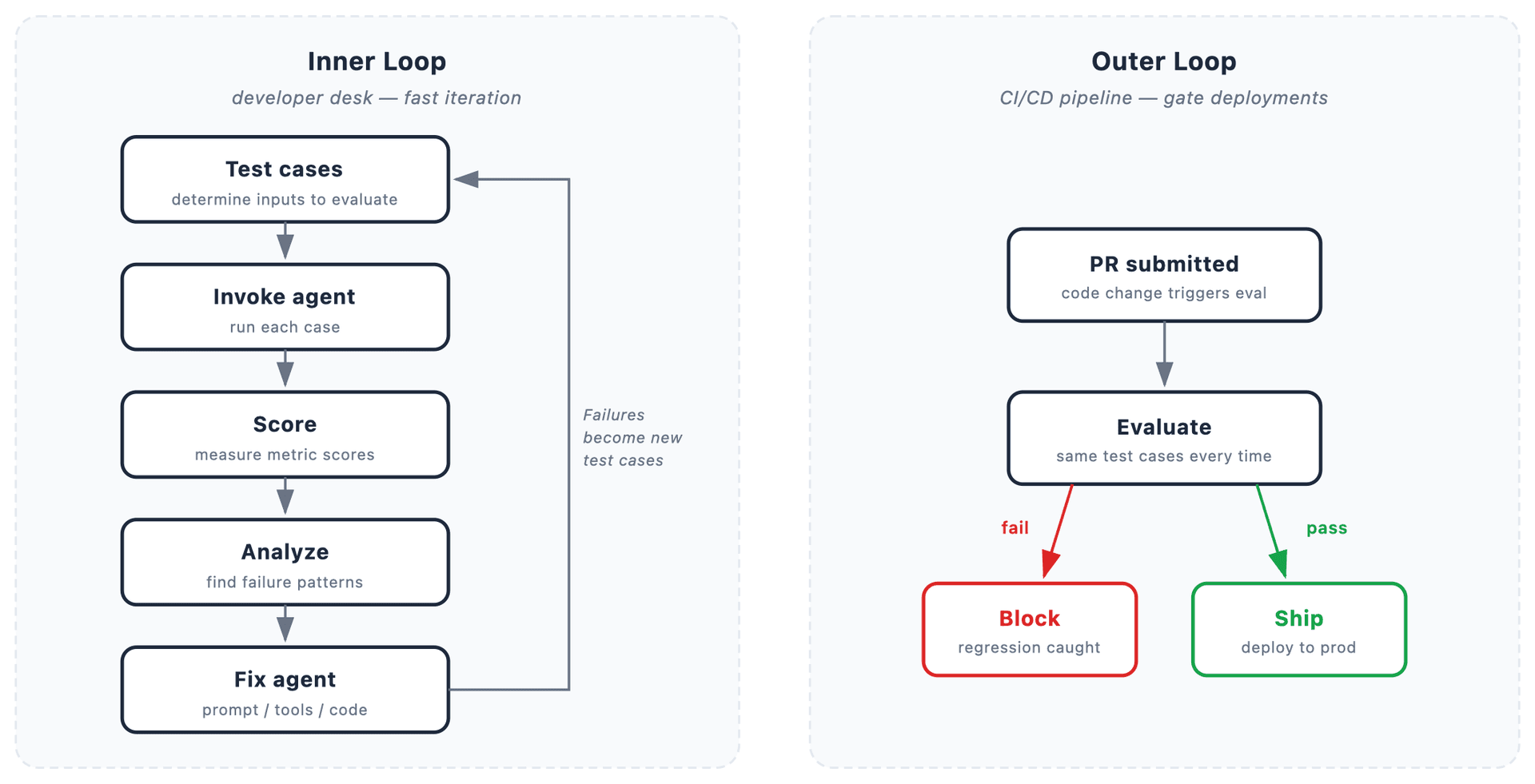
Amazon Bedrock AgentCore now supports versioned dataset management for agent evaluation, allowing teams to maintain stable test baselines alongside production traffic. The feature lets developers author test cases with expected outputs and assertions, then publish immutable versions that serve as regression gates in CI/CD pipelines. This addresses a core problem in agent testing: non-deterministic outputs make it impossible to know whether score changes reflect actual improvements or just sampling variance.

  • Versioned datasets in Bedrock AgentCore lock test cases as immutable checkpoints while allowing mutable drafts for iteration
  • Ground truth assertions (expected outputs, tool sequences, PII checks) distinguish actual correctness from subjective LLM scoring
  • Same locked dataset powers both developer inner loops (minutes-scale iteration) and outer loops (CI/CD regression gates)
  • Production failures automatically become permanent test cases that all future changes must pass

Agent evaluation is fundamentally broken without stable inputs and ground truth. Because LLMs are non-deterministic, the same input produces different outputs across runs, making single evaluation scores meaningless. Without versioned datasets, teams cannot distinguish real improvements from sampling noise or catch regressions before production.

Organizations deploying agents to production need reliable gates that actually catch breaking changes. Versioned datasets eliminate false confidence from passing evaluations that only pass because test inputs shifted, reducing the risk of shipping broken agents and the cost of debugging production failures.

  • Evaluation rigor moves from ad-hoc test cases to disciplined, versioned baselines that persist across sprints and teams
  • Production incidents become permanent test fixtures, forcing all future changes to handle previously discovered failure modes
  • CI/CD pipelines gain meaningful regression detection instead of testing against whatever inputs happened to be nearby

Monitor whether teams actually adopt versioned datasets as a discipline or treat them as optional overhead. Watch for patterns in how production failures get captured and whether they accumulate into comprehensive test suites or remain scattered. Track whether this pattern spreads to other LLM evaluation frameworks beyond Bedrock.

Share

Our Briefing

Weekly signal. No noise. Built for founders, operators, and AI-curious professionals.

No spam. Unsubscribe any time.

Related stories

AdventHealth deploys ChatGPT to cut administrative burden
News

AdventHealth deploys ChatGPT to cut administrative burden

AdventHealth is deploying ChatGPT for Healthcare to streamline clinical and administrative workflows, with the goal of reducing administrative burden on staff and freeing up time for direct patient care. The health system is using OpenAI's healthcare-specific model to handle workflow optimization tasks. This represents a practical application of generative AI in healthcare operations rather than clinical decision-making.

8 days ago· OpenAI
AI Discovers Security Flaws Faster Than Humans Can Patch Them

AI Discovers Security Flaws Faster Than Humans Can Patch Them

Recent high-profile breaches at startups like Mercor and Vercel, combined with Anthropic's disclosure that its Mythos AI model identified thousands of previously unknown cybersecurity vulnerabilities, underscore growing demand for AI-powered security solutions. The article argues that cybersecurity vendors CrowdStrike and Palo Alto Networks, which are integrating AI into their threat detection and response capabilities, represent undervalued investment opportunities as enterprises face mounting pressure to defend against both conventional and AI-discovered attack vectors.

about 1 month ago· The Information
AWS Launches G7e GPU Instances for Cheaper Large Model Inference
TrendingModel Release

AWS Launches G7e GPU Instances for Cheaper Large Model Inference

AWS has launched G7e instances on Amazon SageMaker AI, powered by NVIDIA RTX PRO 6000 Blackwell GPUs with 96 GB of GDDR7 memory per GPU. The instances deliver up to 2.3x inference performance compared to previous-generation G6e instances and support configurations from 1 to 8 GPUs, enabling deployment of large language models up to 300B parameters on the largest 8-GPU node. This represents a significant upgrade in memory bandwidth, networking throughput, and model capacity for generative AI inference workloads.

about 1 month ago· AWS Machine Learning Blog
Anthropic Launches Claude Design for Non-Designers
Model Release

Anthropic Launches Claude Design for Non-Designers

Anthropic has launched Claude Design, a new product aimed at helping non-designers like founders and product managers create visuals quickly to communicate their ideas. The tool addresses a gap for early-stage teams and individuals who need to share concepts visually but lack design expertise or resources. Claude Design integrates with Anthropic's Claude AI platform, leveraging its capabilities to streamline the visual creation process. The launch reflects growing demand for AI-powered design tools that lower barriers to entry for non-technical users.

about 1 month ago· TechCrunch AI