AWS and Snowflake Automate AML Alert Triage with AI
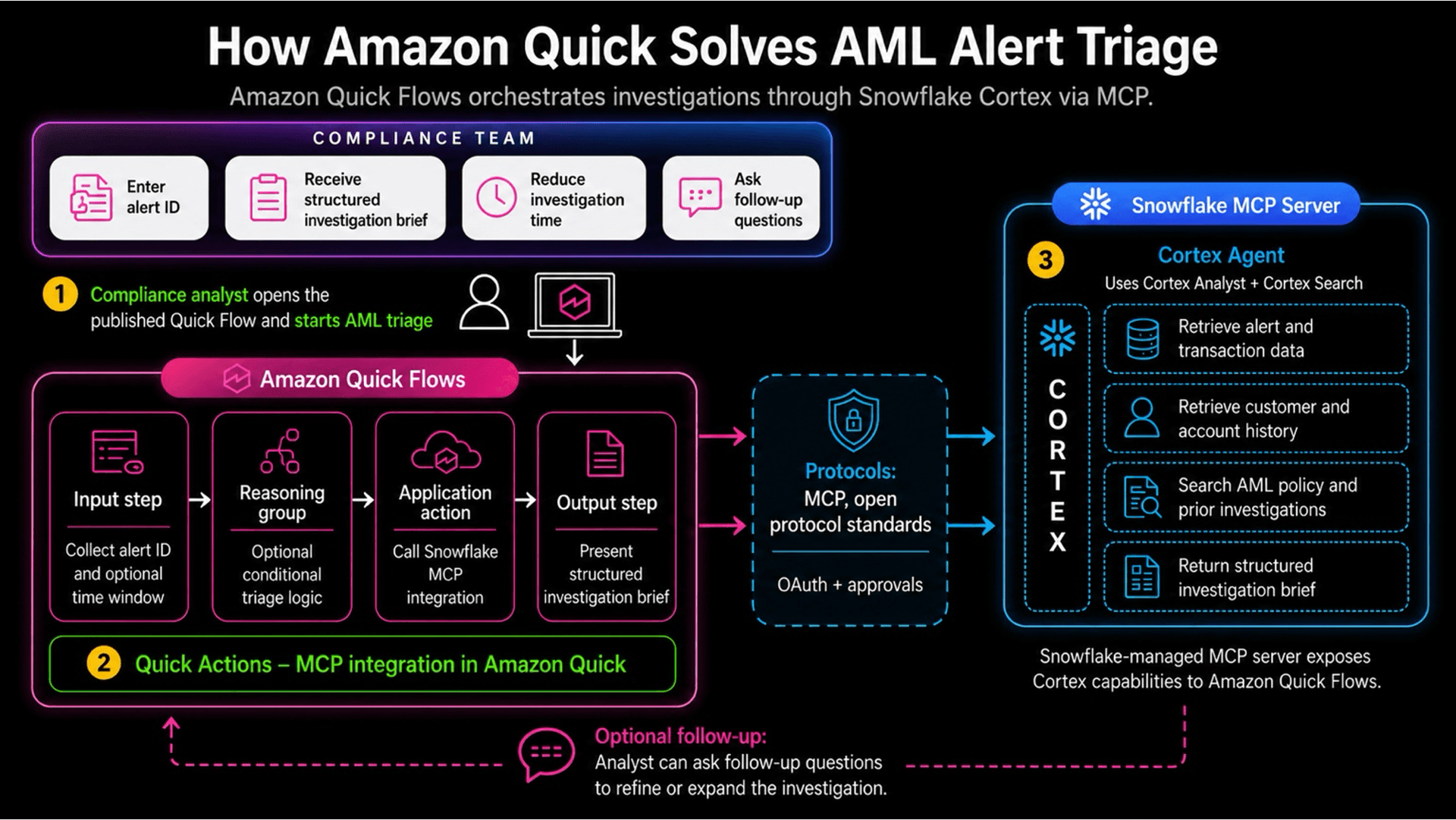
AWS and Snowflake have integrated their platforms to automate anti-money laundering alert triage using Amazon Quick Flows and Snowflake Cortex AI. The workflow reduces alert investigation time from 30-90 minutes to under 5 minutes by automating data collection and disposition narrative generation. The integration leverages the Model Context Protocol to connect tools without custom connectors while maintaining enterprise security standards.
TL;DR
- Amazon Quick Flows and Snowflake Cortex AI automate AML alert triage, reducing investigation time from 30-90 minutes to under 5 minutes
- The solution uses Model Context Protocol (MCP) integration to connect systems without requiring custom connectors
- 90-95% of AML alerts are false positives, making efficient triage critical for compliance teams managing high alert volumes
- The approach applies beyond AML to other repeatable workflows like FinOps cost triage, SRE incident response, and compliance investigations
Why It Matters
AML alert triage is a labor-intensive compliance requirement where most alerts are false positives. Automating this workflow addresses a significant pain point for financial institutions, freeing compliance teams to focus on genuine risks while maintaining regulatory standards. The MCP-based approach demonstrates a broader pattern where AI automation works best on structured, repeatable processes rather than standalone assistants.
Business Impact
Financial institutions can dramatically reduce operational costs and analyst burnout by automating routine alert investigations. The 5-minute processing time versus 30-90 minutes per alert translates to substantial efficiency gains for mid-to-large banks processing thousands of alerts monthly. This automation maintains compliance rigor while improving resource allocation.
Key Implications
- Compliance automation is moving from custom integrations to standardized protocols like MCP, reducing implementation complexity and cost
- AWS and Snowflake's 50+ native integrations position them as a preferred stack for regulated industries requiring secure, compliant AI workflows
- Structured, repeatable processes are the highest-impact use cases for enterprise AI, not general-purpose assistants
What to Watch
Monitor adoption rates among mid-to-large financial institutions and whether the MCP approach becomes standard for compliance workflows. Track whether similar automation patterns emerge in other regulated industries like healthcare and insurance. Watch for competitive responses from other cloud providers and whether custom connector requirements diminish as MCP adoption grows.
Subscribe to the newsletter
The latest stories and analysis, delivered to your inbox.
Free. No spam. Unsubscribe any time.


