VFF - The signal in the noise
News

Verizon Connect scales agentic AI to 100,000 fleet managers
Luca VignaliRead original
Share
Verizon Connect scales agentic AI to 100,000 fleet managers

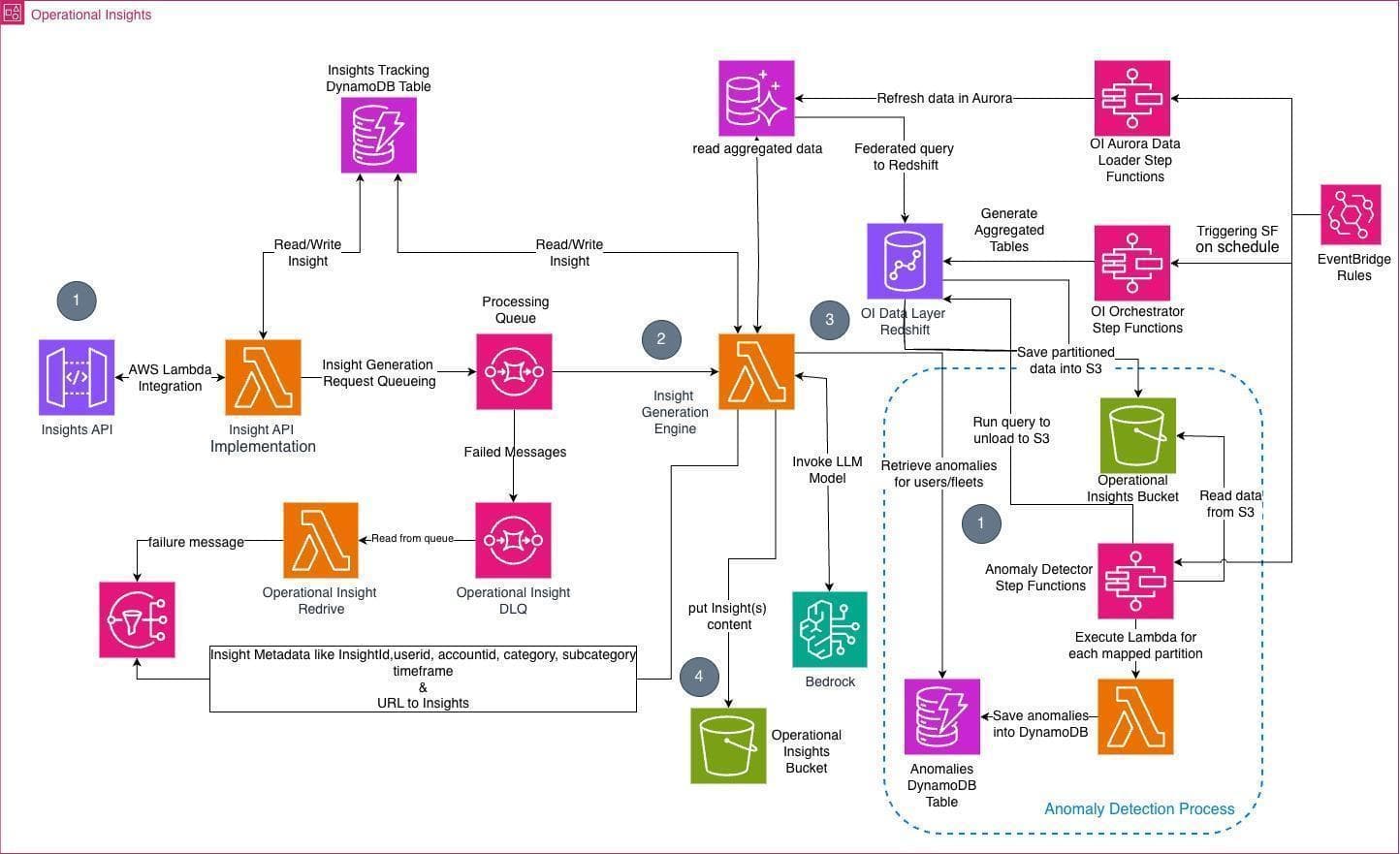
Verizon Connect deployed an agentic AI system to help fleet managers extract actionable insights from 500 million daily data points across 1.2 million vehicle subscriptions. The solution separates numerical anomaly detection from LLM-based reasoning, allowing the AI agent to investigate patterns dynamically rather than relying on static rules. The system now serves 100,000 daily users and demonstrates how specialized architecture can handle data at scale while maintaining cost efficiency.

  • Verizon Connect built agentic AI to transform fleet data overload into actionable insights for 100,000 users daily
  • Architecture separates computationally heavy anomaly detection from LLM-based reasoning to avoid scale and accuracy issues
  • Multiple AI agents run in parallel, each analyzing different customer segments or data subsets for improved performance
  • System queries anomalies for the 'what' and raw data for the 'why', synthesizing both into coherent narratives

Fleet managers handling thousands of vehicles and hundreds of daily data points per vehicle face a critical problem: manual analysis cannot identify emerging safety issues or maintenance needs before they become costly. Agentic AI that dynamically investigates patterns and adapts based on discoveries offers a fundamentally different approach than static dashboards or rule-based systems, addressing the unpredictable nature of fleet operations at scale.

The ability to transform 500 million daily data points into actionable insights reduces reactive problem-solving and enables proactive management of safety, maintenance, and operational efficiency. For fleet operators managing thousands of vehicles, this translates directly to cost savings, reduced downtime, and improved safety outcomes.

  • Agentic AI is more suitable than static automation for domains with unpredictable patterns and high data volume
  • Separating specialized numerical analysis from LLM reasoning improves both performance and cost efficiency at scale
  • Parallel agent execution across customer segments enables horizontal scaling without proportional cost increases

Monitor how other enterprise data platforms adopt similar hybrid architectures that offload numerical work to specialized code while using LLMs for reasoning and synthesis. Watch for adoption patterns in industries with similar data volume challenges, such as logistics, manufacturing, and healthcare, where agentic AI could replace manual analysis workflows.

Share

Our Briefing

Weekly signal. No noise. Built for founders, operators, and AI-curious professionals.

No spam. Unsubscribe any time.

Related stories

AdventHealth deploys ChatGPT to cut administrative burden
News

AdventHealth deploys ChatGPT to cut administrative burden

AdventHealth is deploying ChatGPT for Healthcare to streamline clinical and administrative workflows, with the goal of reducing administrative burden on staff and freeing up time for direct patient care. The health system is using OpenAI's healthcare-specific model to handle workflow optimization tasks. This represents a practical application of generative AI in healthcare operations rather than clinical decision-making.

6 days ago· OpenAI
AI Discovers Security Flaws Faster Than Humans Can Patch Them

AI Discovers Security Flaws Faster Than Humans Can Patch Them

Recent high-profile breaches at startups like Mercor and Vercel, combined with Anthropic's disclosure that its Mythos AI model identified thousands of previously unknown cybersecurity vulnerabilities, underscore growing demand for AI-powered security solutions. The article argues that cybersecurity vendors CrowdStrike and Palo Alto Networks, which are integrating AI into their threat detection and response capabilities, represent undervalued investment opportunities as enterprises face mounting pressure to defend against both conventional and AI-discovered attack vectors.

29 days ago· The Information
AWS Launches G7e GPU Instances for Cheaper Large Model Inference
TrendingModel Release

AWS Launches G7e GPU Instances for Cheaper Large Model Inference

AWS has launched G7e instances on Amazon SageMaker AI, powered by NVIDIA RTX PRO 6000 Blackwell GPUs with 96 GB of GDDR7 memory per GPU. The instances deliver up to 2.3x inference performance compared to previous-generation G6e instances and support configurations from 1 to 8 GPUs, enabling deployment of large language models up to 300B parameters on the largest 8-GPU node. This represents a significant upgrade in memory bandwidth, networking throughput, and model capacity for generative AI inference workloads.

about 1 month ago· AWS Machine Learning Blog
Anthropic Launches Claude Design for Non-Designers
Model Release

Anthropic Launches Claude Design for Non-Designers

Anthropic has launched Claude Design, a new product aimed at helping non-designers like founders and product managers create visuals quickly to communicate their ideas. The tool addresses a gap for early-stage teams and individuals who need to share concepts visually but lack design expertise or resources. Claude Design integrates with Anthropic's Claude AI platform, leveraging its capabilities to streamline the visual creation process. The launch reflects growing demand for AI-powered design tools that lower barriers to entry for non-technical users.

about 1 month ago· TechCrunch AI