vff — the signal in the noise
NewsTrending

Microsoft Loses OpenAI Exclusivity in Landmark Deal Revision
Aaron HolmesRead original
Share
Microsoft Loses OpenAI Exclusivity in Landmark Deal Revision

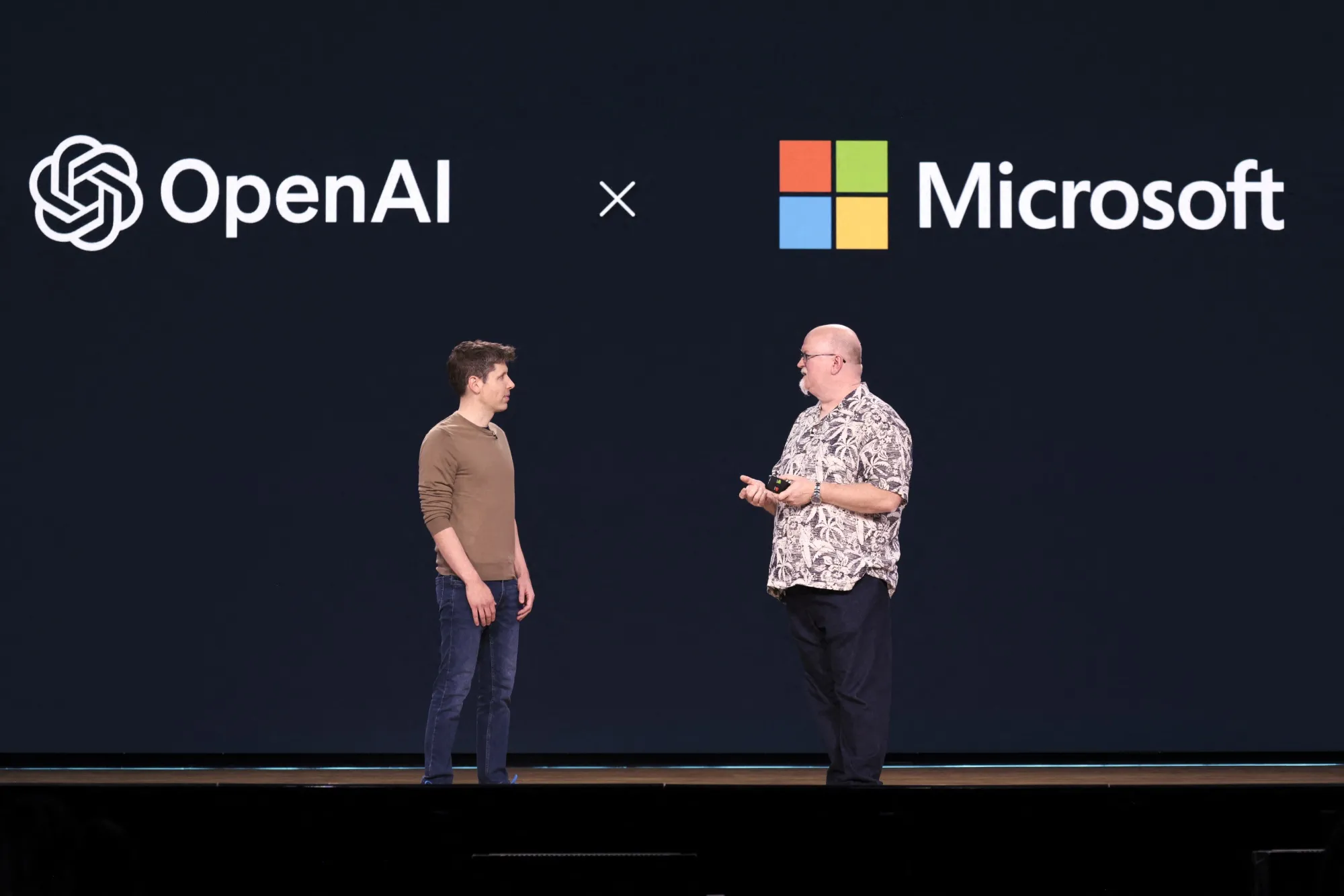
Microsoft and OpenAI have amended their commercial arrangement to allow OpenAI to sell its models through competing cloud providers, ending Microsoft's exclusive distribution rights. The companies also removed a contentious revenue-sharing clause that would have given Microsoft a cut of OpenAI's earnings and certain governance rights. The shift signals a recalibration of one of AI's most closely watched partnerships and reflects OpenAI's push for broader market access.

TL;DR

  • Microsoft loses exclusive rights to distribute OpenAI models on cloud platforms
  • OpenAI can now sell models directly to competing cloud providers
  • Companies scrapped a revenue-sharing clause that granted Microsoft financial upside in OpenAI's business
  • The deal amendment suggests tension over control and distribution in the AI market

Why it matters

The Microsoft-OpenAI partnership has been central to enterprise AI adoption, with Microsoft's Azure cloud as the primary distribution channel for GPT models. Removing exclusivity opens the market and signals that OpenAI wants independence in how its models reach customers, which could reshape cloud provider competition and enterprise AI procurement. The removal of the revenue clause also suggests the companies are moving toward a more transactional, less intertwined relationship.

Business relevance

For enterprises and operators, this means OpenAI models will become available across multiple cloud platforms, reducing lock-in to Azure and creating more competitive pricing and service options. For cloud providers like Google Cloud, AWS, and others, this opens a direct path to offer OpenAI's models without going through Microsoft. For OpenAI, it preserves optionality and reduces dependency on a single distribution partner.

Key implications

  • Cloud provider competition will intensify as OpenAI models become available on multiple platforms, likely driving down margins and increasing feature differentiation
  • Microsoft's leverage over OpenAI's go-to-market strategy has diminished, suggesting OpenAI is asserting more control over its business direction
  • The removal of revenue-sharing indicates the companies are unwinding financial entanglement, moving toward a cleaner vendor relationship rather than a strategic partnership

What to watch

Monitor how quickly OpenAI makes its models available on competing platforms and whether pricing or feature parity differs across providers. Watch for any public statements from Microsoft about its future role in OpenAI's distribution or whether the company shifts strategy toward its own model development. Track whether other cloud providers announce OpenAI model availability and how aggressively they market it.

Share

vff Briefing

Weekly signal. No noise. Built for founders, operators, and AI-curious professionals.

No spam. Unsubscribe any time.

Related stories

Lightweight Model Beats GPT-4o at Robot Gesture Prediction
Research

Lightweight Model Beats GPT-4o at Robot Gesture Prediction

Researchers have developed a lightweight transformer model that generates co-speech gestures for robots by predicting both semantic gesture placement and intensity from text and emotion signals alone, without requiring audio input at inference time. The model outperforms GPT-4o on the BEAT2 dataset for both gesture classification and intensity regression tasks. The approach is computationally efficient enough for real-time deployment on embodied agents, addressing a gap in current robot systems that typically produce only rhythmic beat-like motions rather than semantically meaningful gestures.

3 days ago· ArXiv (cs.AI)
AWS Launches G7e GPU Instances for Cheaper Large Model Inference
TrendingModel Release

AWS Launches G7e GPU Instances for Cheaper Large Model Inference

AWS has launched G7e instances on Amazon SageMaker AI, powered by NVIDIA RTX PRO 6000 Blackwell GPUs with 96 GB of GDDR7 memory per GPU. The instances deliver up to 2.3x inference performance compared to previous-generation G6e instances and support configurations from 1 to 8 GPUs, enabling deployment of large language models up to 300B parameters on the largest 8-GPU node. This represents a significant upgrade in memory bandwidth, networking throughput, and model capacity for generative AI inference workloads.

6 days ago· AWS Machine Learning Blog
Anthropic Launches Claude Design for Non-Designers
Model Release

Anthropic Launches Claude Design for Non-Designers

Anthropic has launched Claude Design, a new product aimed at helping non-designers like founders and product managers create visuals quickly to communicate their ideas. The tool addresses a gap for early-stage teams and individuals who need to share concepts visually but lack design expertise or resources. Claude Design integrates with Anthropic's Claude AI platform, leveraging its capabilities to streamline the visual creation process. The launch reflects growing demand for AI-powered design tools that lower barriers to entry for non-technical users.

7 days ago· TechCrunch AI
Google Splits TPUs Into Training and Inference Chips

Google Splits TPUs Into Training and Inference Chips

Google is splitting its eighth-generation tensor processing units into separate chips optimized for AI training and inference, a shift the company says reflects the rise of AI agents and their distinct computational needs. The training chip delivers 2.8 times the performance of its predecessor at the same price, while the inference processor (TPU 8i) achieves 80% better performance and includes triple the SRAM of the prior generation. Both chips will launch later this year as Google continues its effort to compete with Nvidia in custom AI silicon, though the company is not directly benchmarking against Nvidia's offerings.

5 days ago· Direct