Web Video as Training Data for 3D Scene Understanding
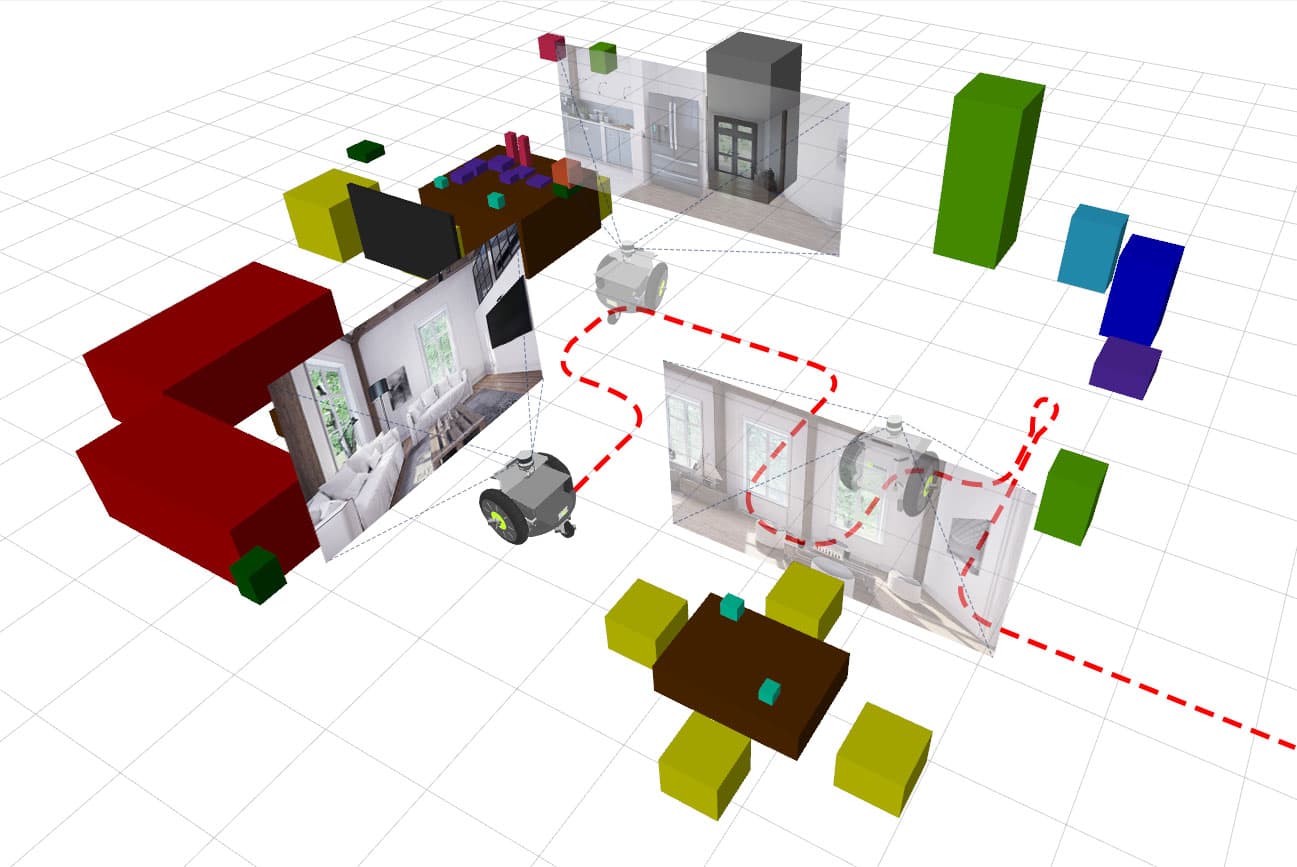
Researchers demonstrate that unlabeled internet videos can be automatically processed into training data for 3D scene understanding tasks, reducing reliance on expensive human annotation. The work uses carefully designed data engines to extract signal from web video, validating the approach across three task categories ranging from object detection to spatial reasoning. Models trained on this generated data show strong zero-shot performance and improve further with finetuning, suggesting a viable path to scaling 3D perception systems without proportional increases in annotation costs.
TL;DR
- Automated data engines can convert unlabeled web videos into usable training data for 3D scene understanding without human annotation
- Approach validated across low-level perception tasks (3D object detection, instance segmentation) and high-level reasoning (3D spatial VQA, Vision-Language Navigation)
- Models trained on generated data achieve strong zero-shot performance and show measurable improvement after finetuning on human-annotated datasets
- Research identifies specific bottlenecks in automated data generation that determine efficiency and effectiveness of learning from unlabeled video
Why It Matters
3D scene understanding remains computationally expensive and data-hungry, with annotation costs a major bottleneck for scaling. This work demonstrates that the abundance of unlabeled video on the internet can be systematically converted into training signal, potentially unlocking a new source of training data at scale. The validation across multiple task granularities, from detection to reasoning, suggests the approach generalizes beyond narrow use cases.
Business Impact
For companies building 3D perception systems, robotics, autonomous vehicles, or spatial AI applications, reducing annotation costs while maintaining model quality directly impacts unit economics and time-to-market. The ability to leverage freely available web data as a training source could shift competitive advantage toward teams with effective data engineering and filtering pipelines rather than those with the largest annotation budgets.
Key Implications
- Unlabeled internet data may become a primary training source for 3D perception tasks, similar to how web-scale data transformed 2D vision and language models
- Data engine design and filtering quality become critical differentiators, as the bottleneck shifts from annotation scarcity to effective signal extraction from noisy web video
- Zero-shot performance from web-generated data suggests models can learn generalizable representations without task-specific human labels, reducing the need for expensive domain-specific annotation
What to Watch
Monitor whether this approach scales to more complex 3D reasoning tasks and whether the quality gap between web-generated and human-annotated data narrows further with improved filtering. Watch for adoption by robotics and autonomous vehicle teams, as they represent the highest-value use cases for 3D scene understanding. Track whether similar data engine techniques transfer to other modalities or whether 3D video presents unique advantages for automated data generation.
Subscribe to the newsletter
The latest stories and analysis, delivered to your inbox.
Free. No spam. Unsubscribe any time.